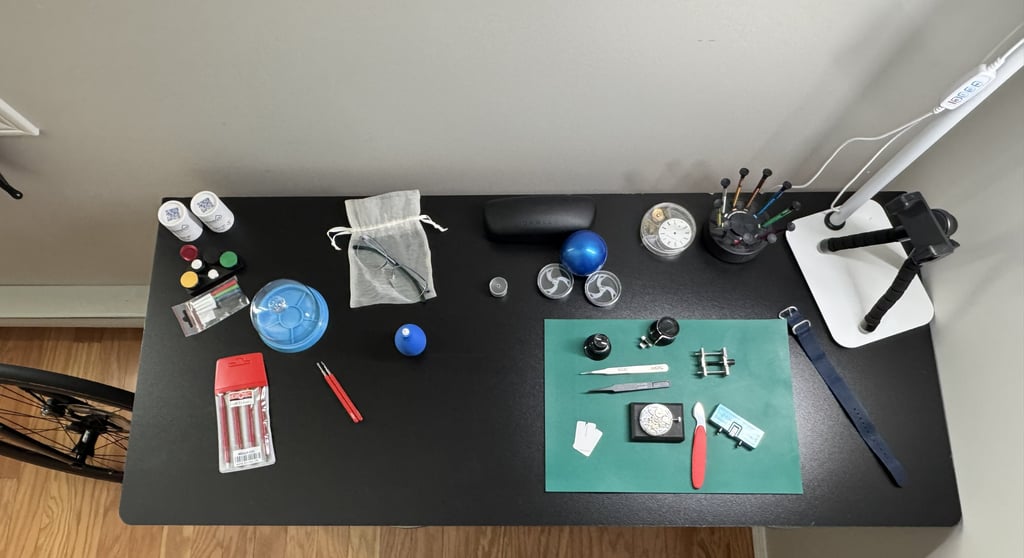
As I mentioned, some of my tools were purchased of Amazon, where I focused on starter items that don't need to be of the highest quality. This included a respirator mask for basic protection when working on older watches with radioactive lume, a watch repair mat, a dial storage box, a four-dish oil holder, an air blower for dust, a two-prong case-back opener, a mini phone tripod for recording the process, and a mainspring barrel closer.
The more specialised watchmaking tools came from a company called Watch of the Cuff. Here I purchased precision equipment such as oilers, a reversible movement holder, antimagnetic tweezers, and a full screwdriver set, along with hand-removing and hand-setting tools, magnification loupes, a case knife, a friction ball, a parts tray, a rubber casing cushion, and antistatic finger cots.
I also added essential cleaning and assembly supplies, including Bergeon Rodico and dial dots, as well as several Moebius lubricants needed to reduce friction and keep a mechanical movement running correctly. In addition, I purchased a practice movement online that, while somewhat expensive, is widely considered easy for beginners to learn on.
Unfortunately, many distributors I came across were not local, which made ordering from them both more expensive and complex. My search eventually led me to Watch of the Cuff, which I was delighted to discover is a local business situated in Milton, Ontario.
The name also sounded familiar, and I soon realised that I had already been subscribed to the owner’s YouTube channel for some time. Knowing that the business is run by Colin made the connection feel even more personal, as I could also place a face to the name.
After placing my order, the tools arrived within a few days, along with a handwritten thank-you note from the Colin. I later sent him an email describing my project, and he replied with genuine encouragement and an open offer of advice whenever I might need it.
In addition to providing an excellent service experience for customers, I also value having a local supplier who can provide genuine, high-quality watchmaking tools without the risk of counterfeit or poorly made items that can sometimes come from large e-commerce sites.
I would recommend looking for a local supplier yourself, and if you are in Canada, this online store is well worth a visit. The Watch of the Cuff YouTube channel is also very helpful for beginners, clearly explaining the purpose and proper use of many essential watchmaking tools.
For readers living in the United States, I also discovered a company through YouTube that may be worth knowing about. It is called Sutcliffe Hansen, and it offers high-quality starter tool kits created in collaboration with Marshall Sutcliffe from the Wristwatch Revival channel. In his videos, he comes across as genuinely honest and trustworthy, and someone I would be happy to support. Overall, Sutcliffe Hansen seem like an excellent and well priced option for anyone based in the States.
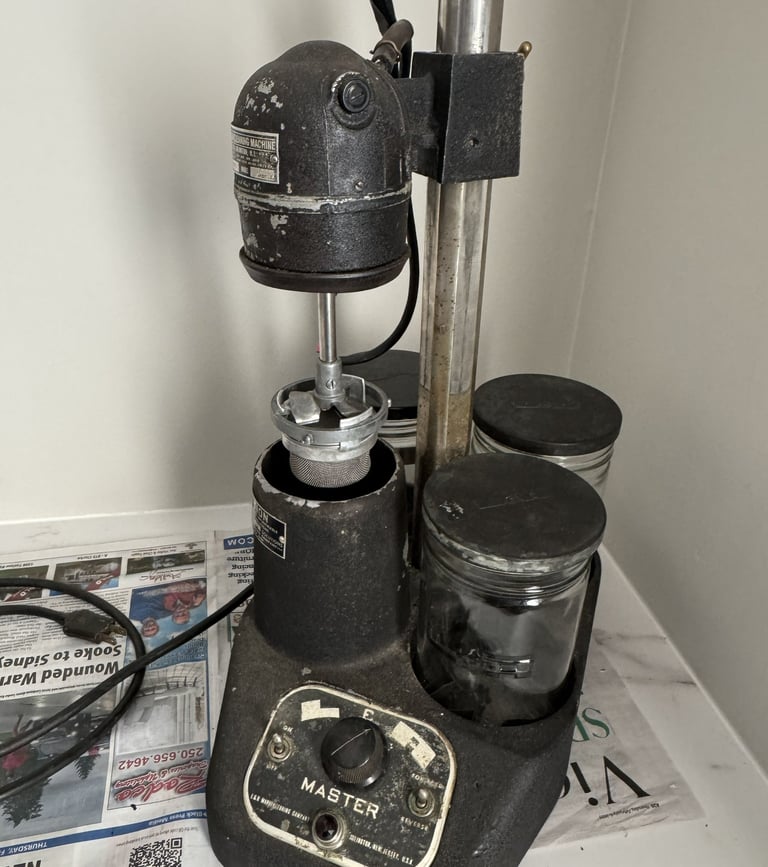
One final purchase worth mentioning is something I am especially excited about, mainly because I never expected to find one I could afford so soon. It was a bit of an impulse buy, but I am glad I came across it. The photo below shows my new vintage L & M watch-cleaning machine.
This fully operational model became available locally from a young clockmaker who had been apprenticing under a more established mentor. After being offered the opportunity to move into a larger shared workshop, he no longer needed some of his older equipment. I visited his small workspace, examined the machine, and decided to bring it home.
If you are working with lower-cost tools that could easily scratch or damage delicate watch parts, I would strongly recommend watching a few tutorials before using them and resisting the urge to practise on a family heirloom or valuable watch too soon.
A better starting point is an inexpensive vintage watch from eBay that can be used for practice. I chose to start on the Seagull ST36 movement because it is widely recommended for beginners. There are also many high-quality disassembly tutorials available online, making troubleshooting much easier when problems arise.
Before we continue though, a bit of advice that came up while I was researching.
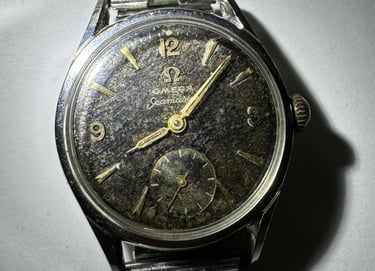
You have to be very careful with older vintage watches! The luminous paint on the dials and hands were produced using either radioactive radium or tritium. Yes, you heard me right, the same stuff Godzilla is made of.
As it ages the lume becomes brittle and flaky which could turn it into airborne dust. I cannot give anyone advice on how to work with radioactive material, but I would strongly recommend that you do not breathe in this substance, as it may cause lifelong radiation concerns if it enters your body.
I suggest rather leaving the watch closed if it is very old and you suspect the presence of radium or tritium. Radium was not always marked, but older dials often show telltale radiation burn marks.
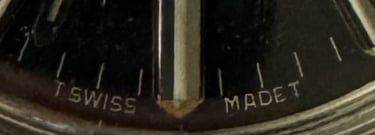
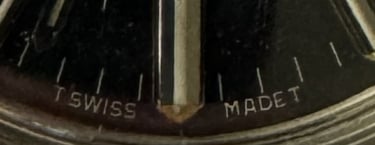
Tritium, in most cases, was marked with a small “T,” usually at the six o’clock position. Fortunately, most newer watches use a chemical lume called Luminova or Super-LumiNova, which I'm told is harmless.
I feel it is very important to tell beginner watchmakers about this lesser-known fact right of the bat, so please, do not go messing with old lume!
In this third post, I want to shift from the story to the process by explaining how I approached purchasing my first watchmaking tools, which ones I chose, and why I chose them. I am also including more photos in this post, along with some starting advice. Relevant YouTube videos that informed today's blog post are listed at the end of this post.
Before listing the tools I purchased, it is worth noting that I probably bought more than I truly needed to begin with. There are numerous YouTube channels that provide a very clear picture of the small number of tools you actually need to start watchmaking.
He was great to talk to, and you could clearly see how much he loves his craft. He also offered me emergency help with tools if I ever needed it and gave me a few spare items from his workshop. He mentioned that refurbishing the cleaning machine might make a good project for the blog in the future. I love the idea, but at the moment I am still a bit too cautious to risk damaging it right after purchasing it. Perhaps the right moment will come later.
So far, the watchmaking community has been a genuine joy to interact with. One of the most rewarding parts of starting this project has been the friendly and encouraging people I have met. These encounters have taught me an important lesson. Every person carries a story, and I have genuinely enjoyed listening to them.
I am starting to realise that listening to and sharing the stories of the people I meet may become an important part of this blog’s future.
In the next post, I will take you through the full disassembly of the ST36 and share what I learned from dismantling a movement for the first time.
Till Next Time...
Personally, I tried to purchase the highest quality tools I could reasonably afford because I am serious about continuing this hobby well into the future and did not want to replace poorly made items that might break or wear out quickly.
For the more expensive purchases, I focused on the pieces that most watchmakers don't skimp on, such as screwdrivers, tweezers, a movement holder, lubricants, oilers, Rodico putty, and eye loupes.
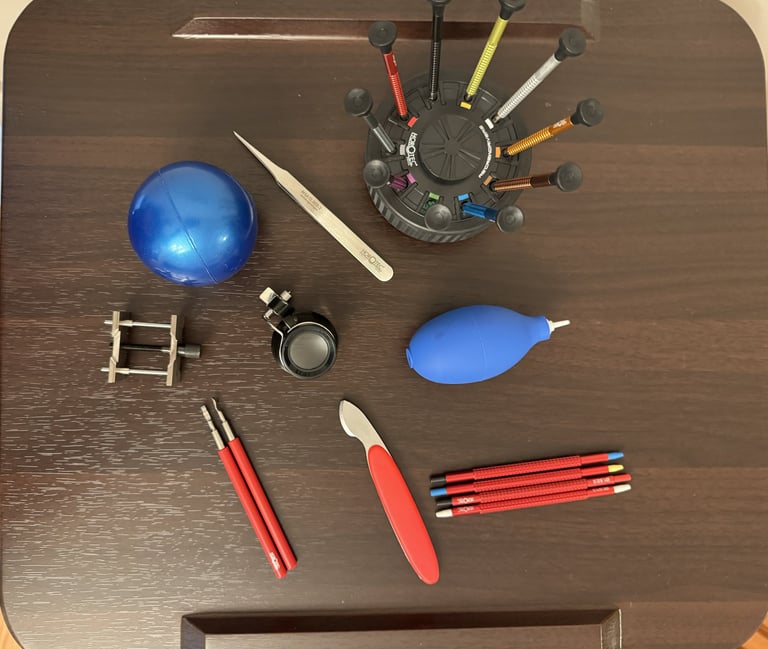
Based on what I currently know, these are my personal recommendations if your just starting out. All of them can be acquired your own price point.
Watch Specific Screwdriver Set
Tweezer
Air Blower
Hand removing Tools
Hand Pressing Tools
Eye Loop
Movement Holder
Caseback Opening Friction Ball
Caseback Knife
Starting Tool Kit Videos:
https://www.youtube.com/watch?v=4tl7xNPvmyM
https://www.youtube.com/watch?v=2tAMDxMqqy8
https://www.youtube.com/watch?v=AW5kMOlhL8M
Watchmaking YouTube Channels I Recommend:
https://www.youtube.com/@watchoffthecuff
https://www.youtube.com/@WristwatchRevival
https://www.youtube.com/@RedDeadRestoration
https://www.youtube.com/@watchrepairtutorials
https://www.youtube.com/@FineWinding
Professional Watch Tool Suppliers: