As some of you may know, I am currently a student at UVic. Like most universities, ours provides a short break each term so that students may, at least in theory, catch up on their reading. In practice, these one-week intervals have a habit of being used for other pursuits, and one of my fellow students decided that the best possible use of the time would be a trip to merry old London in the United Kingdom.
Upon their return I ran into them and asked if they had brought a souvenir from their travels. Surprisingly, this friend of mine who did not know that I am somewhat enthusiastic about watches replied that they had bought the most beautiful vintage watch. They immediately showed me the watch on their wrist, and I have to say it was a beauty and seemed to be in very good condition too.
I was told that it wasn’t running but that they were planning on having it repaired. They referred to it as a quartz watch, so I naturally said that was cool and suggested that perhaps it would only need a battery replacement. My friend replied that it did not run on a battery. I mentioned that I had been interested in watches for some time and that I was fairly certain that all quartz watches run on some form of battery. I then asked if I could take a closer look at the watch.
I brought it up to my ear and slowly and gently turned the crown. Sure enough, there was the familiar sound of the ratchet wheel and the click doing their thing. I couldn’t tell just by looking at it whether it was self-winding or manual-wind, but I told my friend that they were in possession of a mechanical watch and explained the difference.
My friend seemed somewhat perplexed, so I offered the address of my blog in case my musings might help clarify matters. This post then, is something of a small tribute to that friend, who may very well forget to check the blog altogether. But if you do happen to see this, then hello. I hope it brings a bit of clarity for you, and perhaps for a few other readers who have wondered about the same thing.
Also, please keep in mind that this post is not meant to be a technical manual on watchmaking. The goal here is simply to explain the basic ideas in a way that makes sense to someone who is just beginning to look inside a watch. Real watch movements are far more complicated than what is described here, and entire books have been written about the details. Think of this more as a starting point.
The feature image at the top of this post, along with all the others I use today, was created using AI. As you can tell, I had myself a little surrealist moment when I created the prompts. I usually prefer using photos I took myself, but being new to blogging I thought I would experiment with some automation and a different layout. Cue Bob Dylan’s voice here: “The TIIIMES they AAAARE a-CHAAANG-in’.”
Jokes aside, let’s start by defining the movement of a watch. In simple terms, the movement is the engine of the watch.
It is the machine inside that keeps time and moves the hands. From here on out, whenever I use the word movement, I want you to imagine a little engine inside the watch. Most movements (watch engines) fall into three main categories: manual-wind mechanical, automatic-wind mechanical, and quartz. Now read the next part slowly because this is the key point. Each type of movement (watch engine) keeps the hands moving in a different way. Some need you to wind the movement by hand, other movements wind themselves as you move, and others still use a small battery.
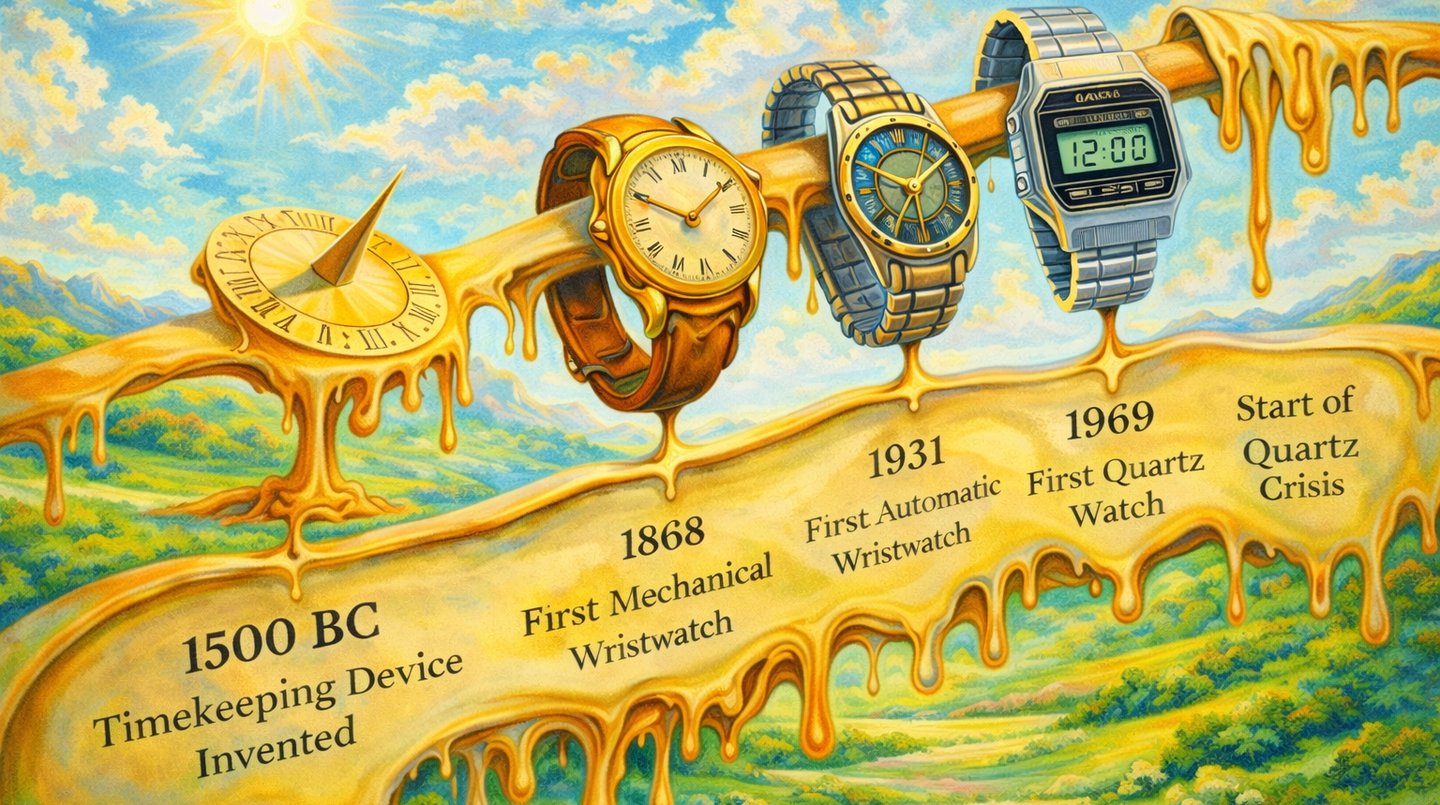
Looking at the feature image, you may notice that it is a timeline. My main intention is to show you where wristwatches lie on the timekeeping timeline, so forgive me for not adding clocks and pocket watches. Starting on the far left you see the first timekeeping device, the sundial, possibly invented around 1500 BC. Moving right we reach 1868, when Patek Philippe supposedly created the first Swiss mechanical wristwatch. The little contraption later known as "the trench watch" became super popular, especially during WW1, because fastening a watch to one’s wrist was far more convenient than carrying a pocket watch or a sundial.
The next major step appears in 1931 when Rolex introduced the first modern automatic wristwatch, which wound itself through the motion of the wrist. Further along we arrive at 1969, when Seiko introduced the first commercial battery powered quartz wristwatch. Finally, on the far right we see the beginning of the Quartz Crisis in the early 1970s. And since every good story deserves a crisis or two, I shall return to that particular episode a little later.
Mechanical watches were the first movements used in wristwatches. These watches contain a small spring tightly compressed inside a little barrel within the watch. Now keep in mind that springs are springy and tend to want to move on their own once compressed.
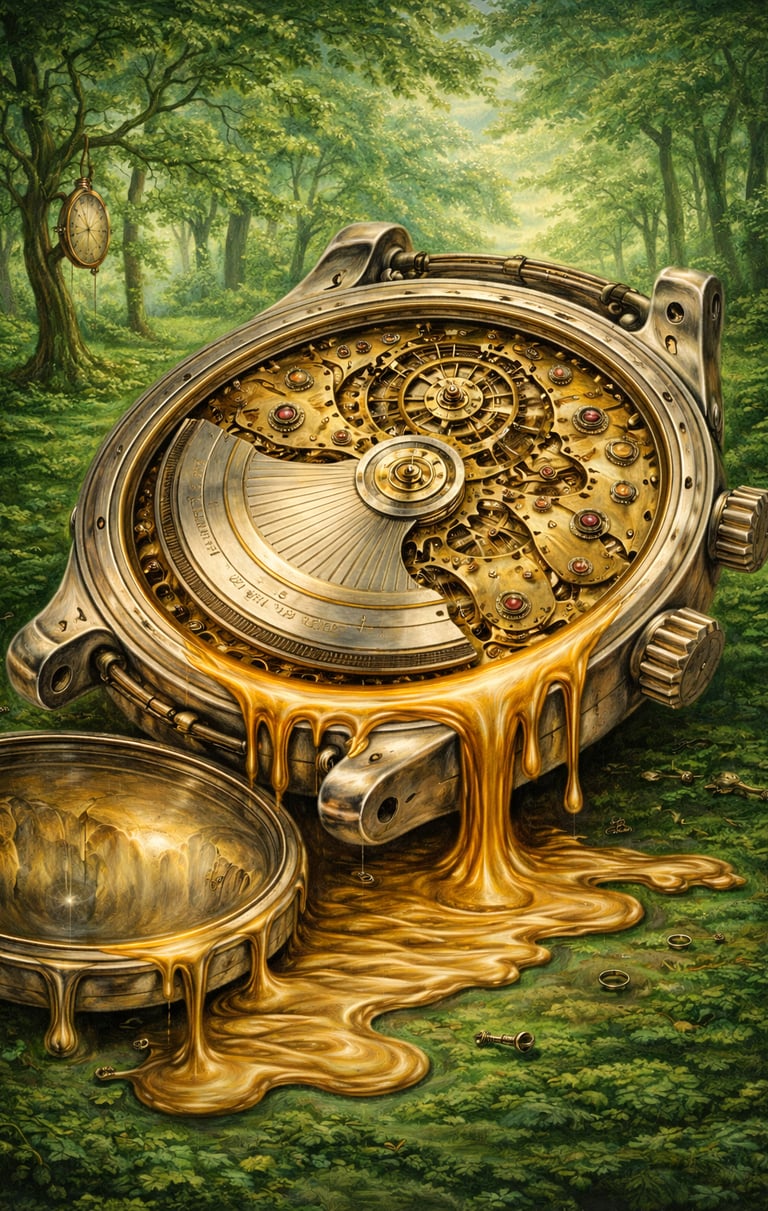
You can think of this spring as the battery of the watch. When you wind the watch, you compress the spring, and once it is tightly compressed it begins to fight to unwind on its own. Springs, as it turns out, do not particularly enjoy being wound tightly into small boxes.
As the spring keeps trying its best to decompress, its slow movement pushes against and turns the tiny wheels inside the watch. These wheels are a bit like prison guards, with their warden being the escape wheel. Together, they only allow the spring to unwind at a certain speed, preventing it from escaping all at once. As the spring unwinds and the wheels turn, the seconds, minutes, and hours move along with them.
Eventually the spring unwinds completely and has no more power left to push against the wheels. When that happens the wheels also stop, and the spring needs to be wound again.


Therefore, a mechanical watch works through pure mechanics. The spring is wound tightly and wants to unwind. The wheels control how slowly it unwinds, allowing the hands to move as the stored power inside the spring is gradually released.
Now, some clever fellow eventually looked at this arrangement and thought that perhaps there might be a way to save the poor owner from having to wind the thing every morning.
This is where the automatic watch enters the story. An automatic movement does not really have a different engine at all. It is simply the same mechanical watch we have just been discussing, but with one small improvement that makes life a little easier for the wearer.
All the important characters are still present and working exactly as before. The spring still lives inside its little barrel and the wheels still stand guard against the spring unwinding too quickly. The only difference is how the spring gets wound inside its little barrel.
In an ordinary mechanical watch the owner must wind the crown by hand, which tightens the spring inside the barrel and gives the watch its strength for the day. With an automatic watch, however, the watch does a bit of this work for itself.
Inside the watch sits an additional little device that a regular mechanical watch does not have. It is called a rotor. It is a half-moon shaped weight that is free to swing around inside the watch like a merry-go-round. Walking, reaching for a cup of coffee, scratching one's head while thinking about important matters, all of it sets the rotor quietly in motion.
That motion does not go to waste. The swinging rotor slowly tightens the mainspring inside its barrel. In this way the spring is constantly being wound as the wearer goes about his life.
As long as the watch remains on the wrist and the wrist continues its usual moving about, the spring keeps being wound. The wheels keep turning and the hands continue their slow march around the dial.
So in the end the automatic watch is still the same mechanical watch we discussed before. The same spring provides the strength, and the same wheels keep the spring from making a run for freedom. The rotor simply acts like a helpful assistant, quietly winding the watch whenever the owner forgets to do it himself.
Some time later, a completely different sort of watch appeared. This one did not rely on springs trying to escape from tiny barrels, nor on patient little wheels standing guard over them. Instead, it turned to something far less mechanical and more electrical in nature.
This was the quartz watch.
Inside a quartz watch there is no tightly wound spring doing its best to unwind. Instead, the watch is powered by a small battery. One might think of the battery as a quiet little power station that sits inside the watch and steadily provides electricity whenever it is needed.
But electricity on its own does not keep time. For that task the quartz watch relies on a rather remarkable little object: a crystal of quartz.
Quartz crystals have a peculiar habit. When electricity passes through them, they begin to vibrate. Not in a wild or unpredictable way, but in a very steady and disciplined fashion. It is almost as if the crystal has decided that if it must vibrate, it might as well do so properly.
In most quartz watches this crystal vibrates exactly 32,768 times every second. That is an astonishing number of tiny shivers for something no larger than a grain of rice. Fortunately, the watch contains a small electronic brain whose sole job is to sit there patiently and count.
This little circuit counts the crystal’s vibrations and groups them together until they add up to one full second. When that moment arrives, the circuit sends a small electrical signal to a device called a stepper motor.
The motor then moves a gear forward by one tiny step. That single step pushes the second hand forward. The same gear train then carries the motion along to the minute hand and the hour hand.
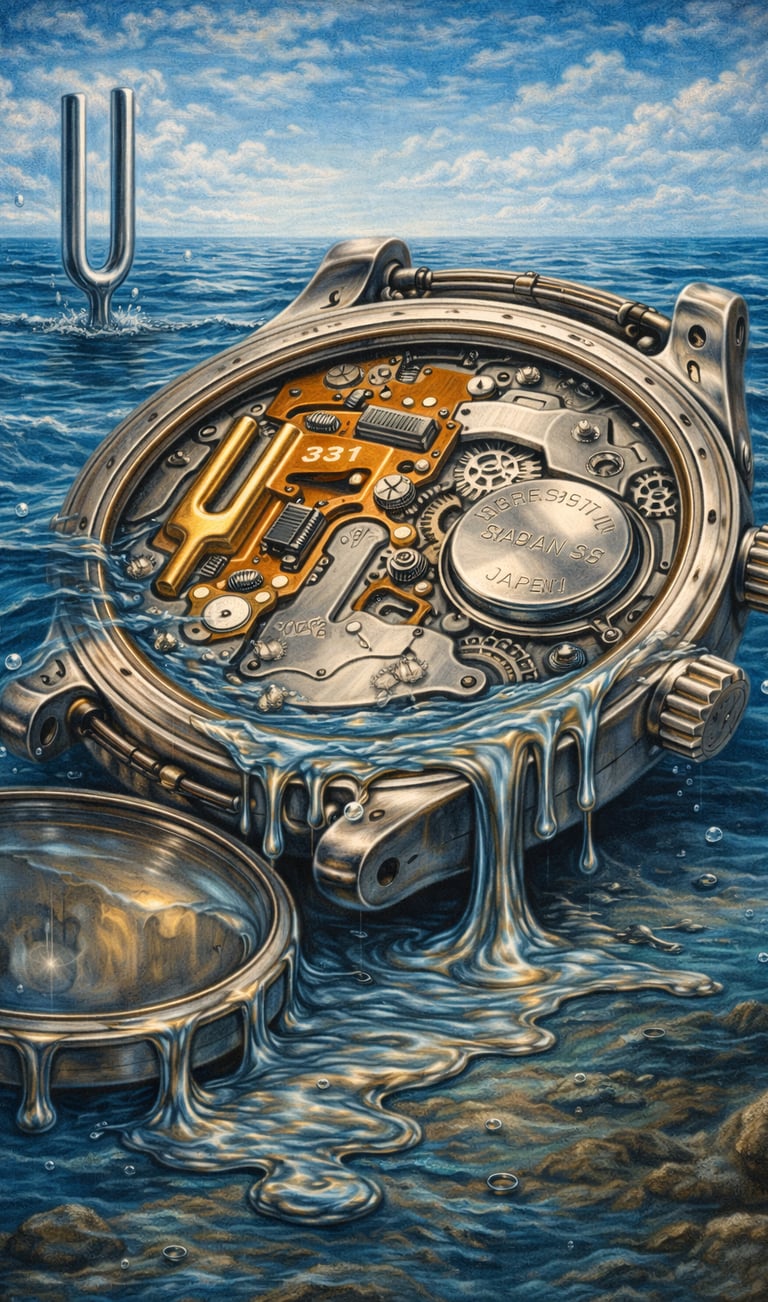
Because the quartz crystal vibrates in such a steady and predictable manner, quartz watches tend to keep time with far greater accuracy than their mechanical cousins. There are also far fewer moving parts inside them, which means they are generally simpler to make and somewhat easier on the wallet.
One might say that while the mechanical watch is a tiny clockwork city full of busy little guards interacting with the imprisoned spring, the quartz watch is more like a quiet laboratory where a crystal sits humming to itself while a small electronic accountant keeps count.
Then, in 1969, something happened that caused a great deal of anxiety in the quiet world of watchmaking.
Up until that point the old mechanical watch had been the undisputed ruler of the wrist. For generations Swiss watchmakers had been patiently building these tiny clockwork cities, polishing wheels, shaping springs, and adjusting balance wheels.
Then along came quartz.
At first it may not have looked like much. A small battery, a tiny crystal, and a few electronic parts probably didn't seem like a proper watch at all to the old masters of the trade. But this modest little invention turned out to be rather troublesome.
Quartz watches were astonishingly accurate. Worse still, they were inexpensive to produce. Factories could make them quickly, and they kept time far better than the mechanical watches that had taken so many hours of careful craftsmanship to build.
Soon the market was flooded with them.
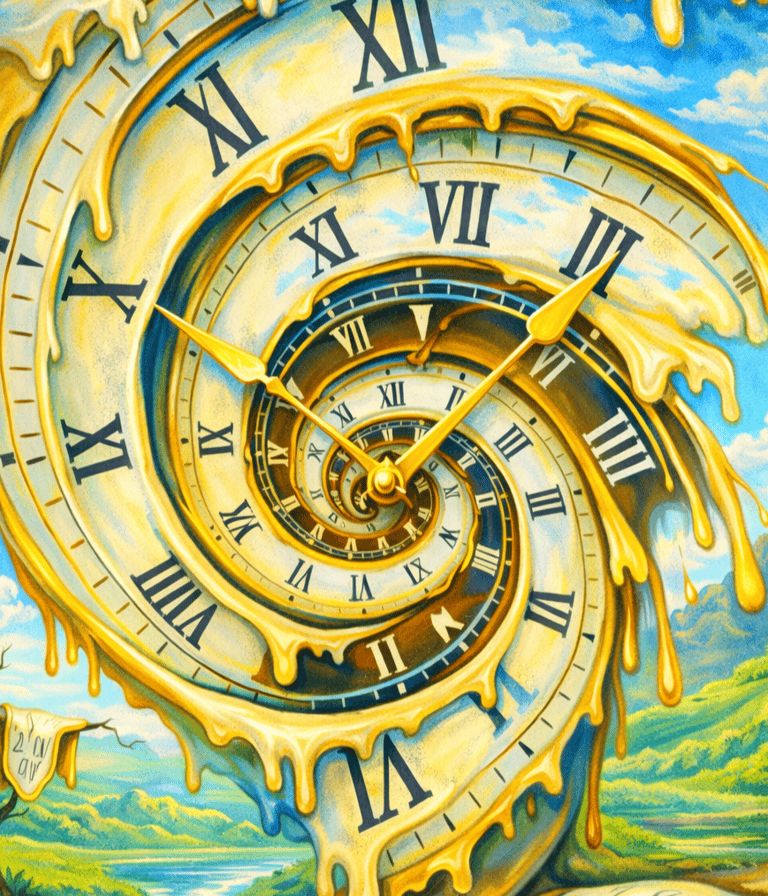
Throughout the 1970s and into the early 1980s, quartz watches began appearing everywhere. They were cheap, reliable, and required almost no fuss from their owners. For many people who simply wanted to know the time, this seemed perfectly adequate.
For the traditional Swiss watchmakers, however, it was something of a disaster. Many old companies simply could not survive the shock. Workshops closed their doors, famous names disappeared, and the number of people employed in Swiss watchmaking fell drastically.
For a time it seemed as though the mechanical watch might quietly disappear altogether.
But fortunately, traditional watchmakers are a stubborn sort of people. Eventually the industry began to rethink its position. If quartz watches were going to win the battle of accuracy and price, then the mechanical watch would have to compete on something else entirely. Instead of being seen simply as a tool for telling time, it began to be appreciated for what it truly was, a small mechanical work of art.
A machine made of dozens, sometimes hundreds, of carefully shaped parts all working together in perfect harmony. That, is exactly what got me hooked on this business, and I suspect many others have fallen into the same trap.
And so it came about that the mechanical watch survived not by being practical, but by becoming something far more interesting. It became the sort of thing a person could admire for years, long after the little quartz crystal had finished its quiet humming.
Till Next Time...
The Editors of Encyclopaedia Britannica. Watch Timekeeping Device. Encyclopaedia Britannica.
https://www.britannica.com/technology/watch/Electric-powered-and-electronic-watches
Wikipedia contributors. Pocket watch. Wikipedia.
https://en.wikipedia.org/wiki/Pocket_watchWikipedia contributors. Patek Philippe. Wikipedia.
https://en.wikipedia.org/wiki/Patek_PhilippeBurlingtons Ltd. Patek Philippe timeline.
https://www.burlingtons.ltd/blog/patek-philippe-timeline/Wikipedia contributors. Trench watch. Wikipedia.
https://en.wikipedia.org/wiki/Trench_watchDoughboy Foundation. How World War I soldiers gave America the wristwatch.
https://doughboy.org/how-world-war-i-soldiers-gave-america-the-wristwatch/Wikipedia contributors. Quartz crisis. Wikipedia.
https://en.wikipedia.org/wiki/Quartz_crisisRolex SA. Perpetual Rotor. https://www.rolex.com/watchmaking/features/movements/perpetual-rotor
Seiko. The 1969 Quartz Astron 35SQ. https://www.seikowatches.com/in-en/products/astron/special/50th_35sq
Wikipedia contributors. (n.d.). Quartz crisis. Wikipedia. Retrieved March 8, 2026, from https://en.wikipedia.org/wiki/Quartz_crisis
Wikipedia contributors. History of sundials. Wikipedia. https://en.wikipedia.org/wiki/History_of_sundials
Bronkhorst, W. My Brain. Not peer reviewed and off by about 23 seconds a day.