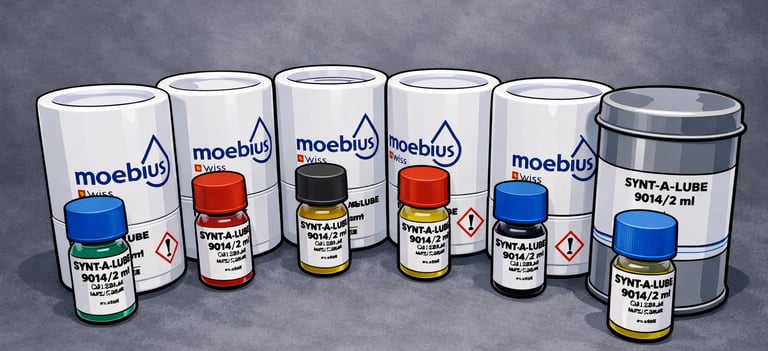
Most beginners should try to start with the oils that are most commonly used in general servicing. Many suppliers bundle these together in starter kits. With these oils, you can service most mechanical movements without needing the full range of lubricants used by large service centres.
For that reason, many watchmakers and hobbyists suggest beginning with the following four lubricants.
9010: Thin oil
9415: Medium oil
1300 / 9104: Thick oil
9501 / 9504: Thicker grease
With these four oils alone, a beginner can lubricate most of the critical areas of a mechanical watch. If you are curious about the full lubrication chart used by manufacturers, you can click here to see it.
Watch Lubrication
A mechanical watch is made almost entirely of metal parts rubbing against other metal parts, yet somehow it keeps time for years without wearing itself into dust.
This small miracle is made possible by lubrication.
Unfortunately, watch oil is very expensive. It usually comes in tiny jars that contain about 2 mL, costing around $60 each. To give you an idea of how expensive that is, imagine a bottle of champagne that costs about $1000. If you filled that same champagne bottle with watch oil, it would cost about $22,500.
Sadly, you cannot do without it. The good news is that 2 mL of watch oil lasts much longer than 2 mL of champagne, so it balances out in the end. Without oil, a watch would only run for a short time before friction slowed everything down and wear started damaging the tiny pivots and wheels.
However, unlike oil in a car engine, watch oil must be used in microscopic quantities. Too much oil is often worse than too little. Oil spreads, creeps, and migrates, and if it reaches the wrong place it can interfere with the delicate action of the escapement.
Watchmakers therefore do not simply "oil a watch." They typically place extremely small and deliberate droplets exactly where they belong.
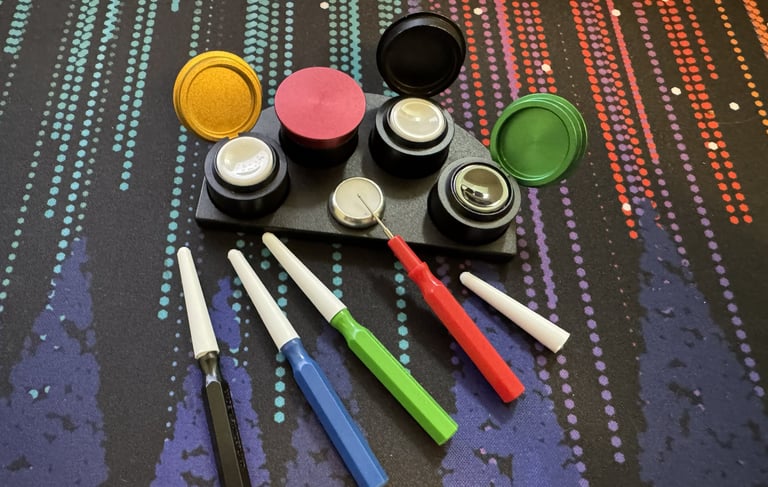
In watchmaking, oil is applied with tools called oilers. These are extremely fine needles designed to pick up a small bead of oil and transfer it to a pivot jewel or contact surface.
The oil itself is usually placed in a small container called a cup holder. This holder has several tiny wells where different oils can be placed during a service. Using the cup keeps things organized so you can quickly switch between oils while your working on the various parts of the movement.
Loading the cup holder is done carefully. A tiny drop of oil is transferred from the bottle into the well, usually with a tweezer or a clean syringe. Only a small bead is needed. The idea is to work from the cup, not from the original bottle, so the main supply stays clean and protected.
Once the oil is in the cup, the watchmaker dips the tip of the oiler into the oil. The goal is not to scoop up oil but to pick up a very small bead that sits on the tip of the needle. When touched to the jewel or contact point, the oil naturally transfers by capillary action and settles into the correct place.
Contamination is one of the biggest concerns when working with watch oils. Dust, fibers, and hair can ruin a small supply of oil. A single piece of lint in a jewel hole can cause friction or carry abrasive particles into the movement or stop the watch completely. For this reason, oil cups usually have lids that should remain closed whenever the oil is not being used.
Keeping the oilers clean is just as important. Oilers are usually wiped on clean watch paper or lightly cleaned in a small amount of solvent if they become contaminated. Some watchmakers also dedicate specific oilers to specific oils so that thicker oils are not accidentally mixed with thinner ones.
Historically, watch oils came from natural sources. One of the most well-known examples was sperm whale oil, which watchmakers valued because it lubricated well and resisted drying out better than many other natural oils.
These oils did the job, but they had a couple of drawbacks. Over time, natural oils tend to oxidize and thicken, which eventually causes a watch to run poorly. They were also not always consistent. Different batches could behave slightly differently depending on how they were produced and refined.
For this reason, modern watchmaking has largely moved to synthetic oils. These lubricants are engineered specifically for the conditions inside a watch movement. They remain stable for longer periods, behave more predictably in very small amounts, and generally allow for longer service intervals.
This was one of the things that made me pause when I first started looking into watch oils. I wanted to buy the synthetic lubricants, but the natural ones are super tempting because of the lower price. In the end, I went with a bit of a combination. I bought two synthetic oils and one small container of the natural stuff. If I could go back in time, I would probably just buy all synthetic, because I suspect I will stop using the natural lubricant as soon as I eventually pick up a synthetic replacement.
Though not entirely accurate and probably not very PC, it is helpful for a beginner hobbyist to think about watch lubricants in terms of four categories: thin oil, medium oil, thick oil, and thicker grease. The more runny the oil is, the more it tends to be used on tiny, fast-moving parts where friction must be kept very low. As the lubricant becomes thicker, it is usually applied to larger, slower parts where loads are higher or where there is more direct metal-on-metal contact.
Moebius 9010 : A very light synthetic oil used for fast-moving pivots such as the balance staff and the faster parts of the gear train. It is widely considered one of the standard oils used in modern mechanical movements.
Moebius 9020 : A slightly thicker oil than 9010. It is used where a little more lubrication strength is needed but the pivot still moves relatively quickly.
Moebius 1300 / 9104 : A medium-viscosity oil used for slower moving parts in the gear train. It is often applied to larger pivots such as the centre wheel or barrel arbor where loads are higher and speeds are slower. Moebius 9104 is a modern synthetic oil that largely replaces the older 1300.
Moebius 9415 : This is a specialised lubricant used on the pallet stones of the escapement. It is designed to handle the impulse contact between the pallet stones and the escape wheel teeth, which is one of the most demanding mechanical interactions inside the watch.
Moebius 941 : An earlier escapement lubricant used for the same purpose. Some watchmakers still use it, although 9415 has largely become the modern standard.
Moebius 8217 : A braking grease used in the barrel walls of automatic watches. It controls the slipping of the mainspring bridle so the spring does not wind too tightly and the power delivery remains stable.
Moebius 8000 : A thicker grease commonly used on mainsprings inside the barrel. It reduces friction as the spring winds and unwinds along the barrel wall.
Moebius 9501 / 9504 : Greases used for high-friction sliding parts such as the keyless works, cannon pinion, and other components involved in the winding and hand-setting mechanisms.
Final Thoughts
Metal touching metal creates friction, and friction eventually leads to wear. We cannot change the rules of physics, but we can work with them by being careful and deliberate in how we service a watch.
Oil is simply the watchmaker’s way of reducing that natural friction.
A tiny droplet of oil placed carefully in a jewel can help a watch run smoothly and keep accurate time for much longer than it otherwise would.
Buying Watch Oils
When it comes time to purchase oils, there are two things worth keeping in mind.
First, buy reputable products from reputable suppliers. The current industry standard oils are produced by a company called Moebius. Counterfeit oils do exist, and honestly, using something that could be used cooking oil for all you know is just silly. Wait, save up, and buy the real thing. I personally bought my oils from Watch Off the Cuff in Canada, but Sutcliffe Hanson and Esslinger also seem to be credible options if you live in the United States. For readers in Europe, CousinsUK is another well-known supplier. As always though, remember to do your own homework before buying.
Second, do not buy more than you need. These oils last a long time, but they do slowly degrade once opened. I currently have only two of the four essential lubricants listed above, but I will add more in time and as my experience grows. In watchmaking, as in most crafts, tools tend to accumulate naturally over time, so there is no need to purchase the entire catalogue on day one.